


Best Leather Sling Bags for Women: 6 Handcrafted Styles That Actually Work
Sling bags are one of those things that sound simple until you go looking for one. You want something that fits your phone, your cards, maybe a lip balm, and your keys, but not a bag so tiny it's more decorative than functional. You want leather, because synthetic wears poorly and you'd rather buy once. And you'd prefer it didn't look like airport security clearance.
It's a narrow brief. Good leather sling bags for women are not hard to find — they're just harder to find than they should be.
The six bags below are handcrafted from genuine leather. Each one has a specific use case, a specific silhouette, and honest details about what fits inside. No vague superlatives. Just what you need to know.
6 Leather Sling Bags Worth Considering

1. Brick Sling Bag
The Brick is compact and keeps its shape - full or empty, it doesn't slump. It fits a phone, keys, and sunglasses. That's genuinely it. No wallet stuffed with loyalty cards, no notebook, no charger. Just the things you grab when you don't want to think about what you're carrying.
The leather straps are adjustable, so the fit changes with what you're wearing. Worn higher, it reads more put-together; lower and it's casual. Either way, it's genuine leather all the way through, nothing synthetic padding out the construction.
Good for running errands, short days out, or any occasion where the goal is carrying less on purpose.
2. Roll Up Sling
The closure is a roll-top with a magnet. You roll the top down, press it closed, done. It's not a zip, and it's not a flap — it takes about two seconds to get used to, and then it just works. The zip compartment inside is for the things you actually want secured: cards, cash, anything that shouldn't migrate to the bottom.
Handcrafted leather, adjustable shoulder strap. The rolled top gives the bag a slightly workwear quality — not precious, not fussy.
Best for: Travel, or anyone tired of bags that all open the same way. Roll-top closures also keep things in if the bag tips over, which sounds minor until it saves your headphones from a puddle.
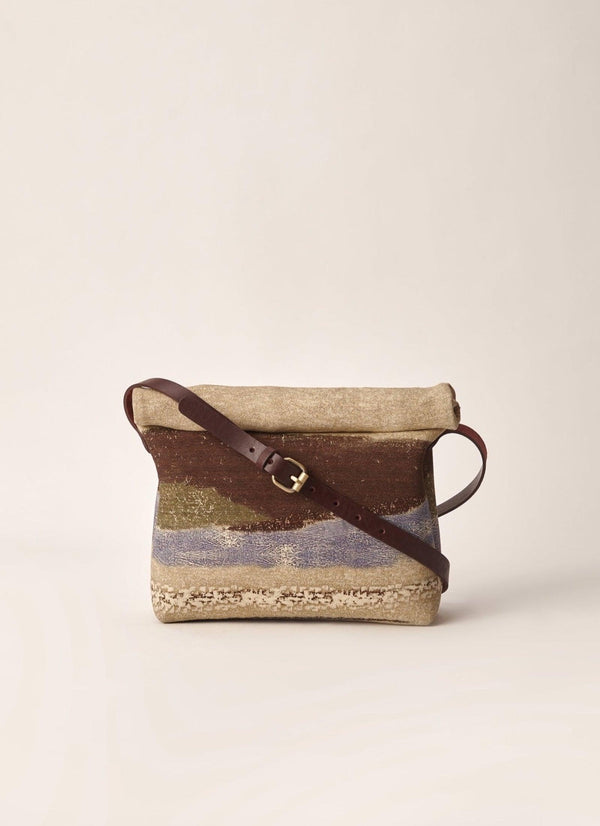

3. Bevelled Sling
The hand-woven strap does most of the talking. A plain strap is just a plain strap; this one has actual texture to it — something to look at, something you feel when you pick it up. The bag has three compartments and a built-in card slot, so you're not fishing around for a separate card holder every time you need to tap in or pay.
The flap closure is quick — secure enough that things don't fall out, but not the kind you're wrestling with one-handed. Small crossbody energy, basically, in a sling format. Everything has a place, and you stop noticing the bag after the first few days, which is the point.
Best for: Daily use where you actually need the bag to do its job, not just look like it could.
4. Noah Sling
The Noah works as both a sling and a clutch. The magnetic partition inside keeps cash, cards, phone, and basic makeup in separate compartments — so you're not fishing around at the bottom of the bag when the lights are low.
It's small. That's the point. The Noah is for nights when you've already made the decision about what stays home. If you tend to overpack, it'll feel limiting. If you like a clear-out, it suits that perfectly.
Best for: Dinner, events, a night out where switching bags mid-evening isn't an option.


5. Phone Sling
Cherry leather, single pocket, knot detailing at the strap ends. The Phone Sling is exactly what it sounds like — phone, a card or two, maybe a slim lip balm. That's genuinely the whole brief, and it doesn't pretend otherwise.
The knot detail is a small thing that ends up doing a lot. It keeps the bag from looking like a basic utility piece, without trying too hard about it. You'd notice it on someone else before you could explain why.
Best for: Days when you're actively choosing to carry less. Doubles as a crossbody when your hands need to be free.
6. Dolby Sling Bag
The Dolby's shape is the whole point. Rugby-ball silhouette — elongated oval, slightly curved at both ends — sits against your hip differently than any rectangular bag. It follows the body rather than cutting against it.
Plated leather gives the surface a polished finish that plain leather doesn't have. It catches light. The adjustable strap means you can wear it higher or lower depending on what you're going for.
Compact, yes. But the shape reads as considered in a way a standard sling doesn't. You'd wear this when the bag is part of the outfit, not just something you grabbed on the way out.
Best for: Evenings, dinners, anywhere the details of what you're carrying actually matter.

How to Choose Between Them
The honest way to choose a leather sling bag is to start with what you actually carry, not what you think you should carry.
If your real daily essentials are phone, cards, and keys — the Brick or Phone Sling covers that cleanly. If you want a little more organisation without moving up to a full shoulder bag, the Bevelled Sling's three compartments and card slot do that job. For evenings specifically, the Noah's internal partition keeps things from getting jumbled at the bottom of the bag; cash, cards, and your phone each have a place.
The Roll Up is for people who like functional novelty — it works, it's different, and it's secure. The Dolby is for people who want the bag's shape to be part of the outfit, not just something hanging off it.
None of these is the wrong choice. They just fit different habits.
Why Genuine Leather Holds Up
Genuine leather ages in a way synthetic materials don't. With use, the surface develops depth — what leather people call a patina. The bag you've carried for three years looks richer than the one you bought. Not worse.
Synthetic sling bags go the other direction. They look fine when new, then start to peel or crack or lose their shape — usually right around the time you've decided you actually like the bag. Leather, with occasional conditioning and some common sense about rain, just doesn't do that.
For something you're using most days, the longevity gap is real. It's not about paying more for prestige. It's about not replacing the same bag every two years.
FAQs
Q1. How do I choose a leather sling bag?
A: Start with what you actually carry, not what sounds sensible. A three-compartment sling seems organised until you realise you only ever use two. Measure your phone first — a lot of compact slings are sized around phones up to a specific dimension and larger ones won't lie flat. Then think about the closure: zips are more secure, magnetic flaps are faster. Roll-top closures are unusual but genuinely good for travel. And if you're sharing the bag or switching between wearing it high and low, adjustable straps aren't optional.
Q2. What are the benefits of leather sling bags?
A leather sling keeps your hands free and sits closer to your body than a shoulder bag or tote. The single diagonal strap holds the bag against your back or chest when you're moving — it doesn't swing at your side. Genuine leather holds its shape over time and won't peel or crack the way synthetics do. If most of what you carry daily fits in your palm, a sling covers it without the bulk of a full bag.
Q3. What features should a good sling bag have?
An adjustable strap is the one non-negotiable. Fixed-length straps are a gamble — they fit some people well and everyone else awkwardly, and there's no way to know which camp you're in until you're wearing it. Interior organisation matters more than people expect too: even a single zip compartment alongside an open pocket is enough to stop everything from pooling at the bottom. A secure closure (zip, magnetic flap, snap) is worth caring about if you're in crowds or moving quickly. Built-in card slots are genuinely useful — one less thing to fish out separately. After those four things, it really does come down to personal preference: shape, material, hardware finish, how many pockets feel like enough.
Q4. How do you describe a sling bag?
A sling bag is a small to medium bag with one diagonal strap — worn across the back, chest, or hip depending on how you adjust it. It's built around carrying less: phone, wallet, keys, maybe one or two other things. Not everything you own. The difference from a backpack is the strap setup — two straps versus one, symmetrical versus diagonal. The difference from a shoulder bag is how it sits: a shoulder bag hangs at your side, a sling stays closer to your body. That contact is actually useful when you're moving through a crowd. Leather versions hold their shape better than canvas and don't deteriorate the way synthetic materials do. That's the main practical argument for them.
